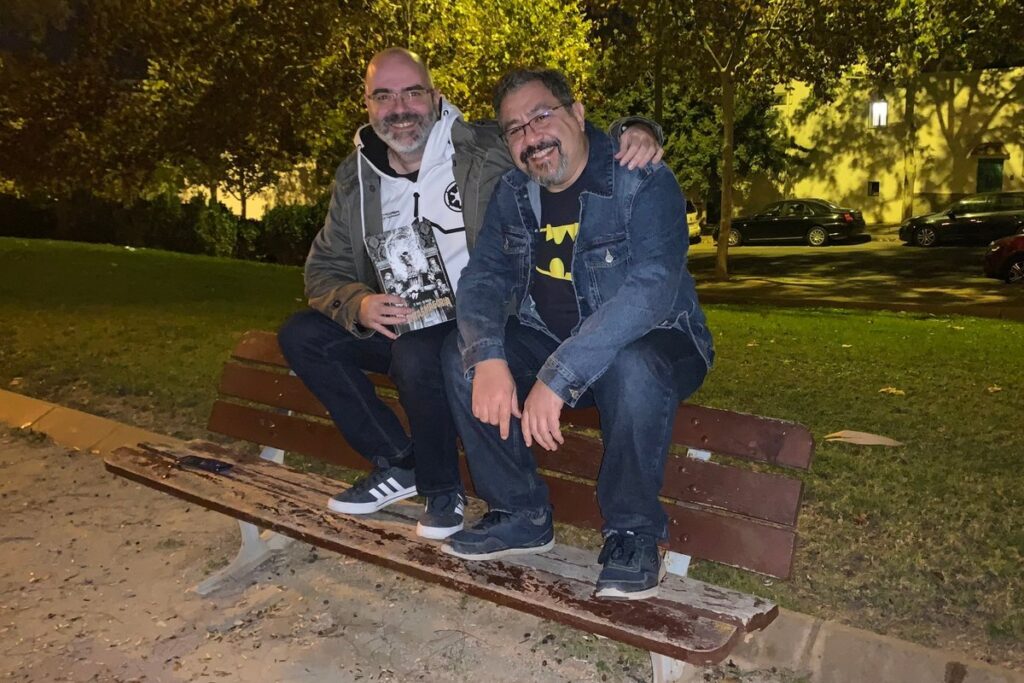
I’m not here to talk about one of my comics today. Well, a little, because I don’t know how to talk about anything else. But mostly I’m here to tell you about a friend. One of those people who appear in the credits of almost nothing and are behind almost everything.
His name is David Ostos, we’ve known each other since we were kids, and without him my bibliography would be missing a comic, a record and one of the most moving nights of my life. So get comfortable: this is going to be a long one, and I intend to enjoy it.
A bedroom, a cassette deck and two lunatics
Málaga, the Colonia de Santa Inés neighbourhood, more years ago than I care to admit. Two teenagers shut in a bedroom with a radio-cassette player, a pile of records and no shame whatsoever. We recorded “radio shows”. In quotation marks, because nobody was ever going to broadcast them and because, if anyone had, we’d have been arrested. We introduced songs, did voices, fooled around and had the time of our lives.
The bedroom was David’s. So were the records. And the passion, even then, was his: electronic music. My head was in comics and his was in synthesizers, and neither of us knew that would turn out to be our trade. But David already had something he has never lost: the urge to make things happen. To bring people together, to pull projects out of thin air, to create culture in a part of the world where that tends to cost twice as much.
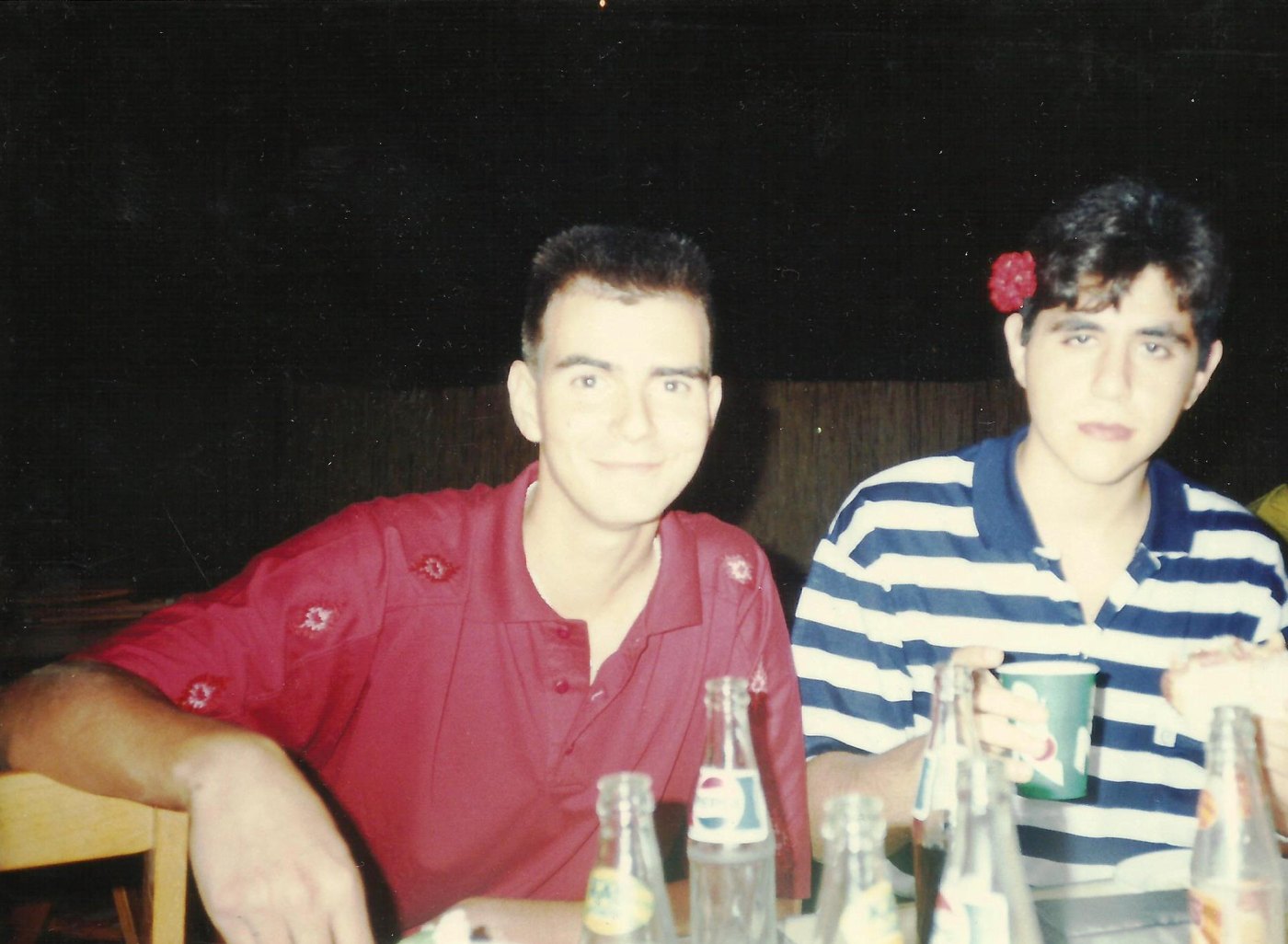
Among the records playing in that bedroom were some that were almost a religion: the ones by Azul y Negro. Remember the name. It comes back.
The blue and black cables
For those who weren’t around: Azul y Negro were the pioneers of techno-pop in Spain. Carlos García Vaso and Joaquín Montoya started out in 1981, and the name, as they tell it, comes from the colours of Inter Milan and from the power cables electronic music is made with. They wrote No controlo nada, La Torre de Madrid, La noche and, above all, Me estoy volviendo loco (“I’m Going Crazy”), which half of Spain remembers as the theme of the Vuelta cycling race without knowing who it’s by. A gold record with Digital in 1983 and, they say, the credit for releasing the first CD ever made in Spain: Suspense, in 1984.
That’s what David and I listened to as teenagers. And now for the twist.
Nearly thirty years later, David was no longer the kid with the cassette deck. He was running, practically single-handed, Amuza Producciones, a small and stubborn outfit from Málaga determined to release electronic music on physical formats, and he had teamed up with Carlos Vaso, who was keeping Azul y Negro alive. And one day he came to me with one of his ideas: what if we made a comic out of their songs?
Not a band biography, and not a comic “about” music. A comic that grew out of the songs, published together with the record.
That’s how Silencio de metal was born.
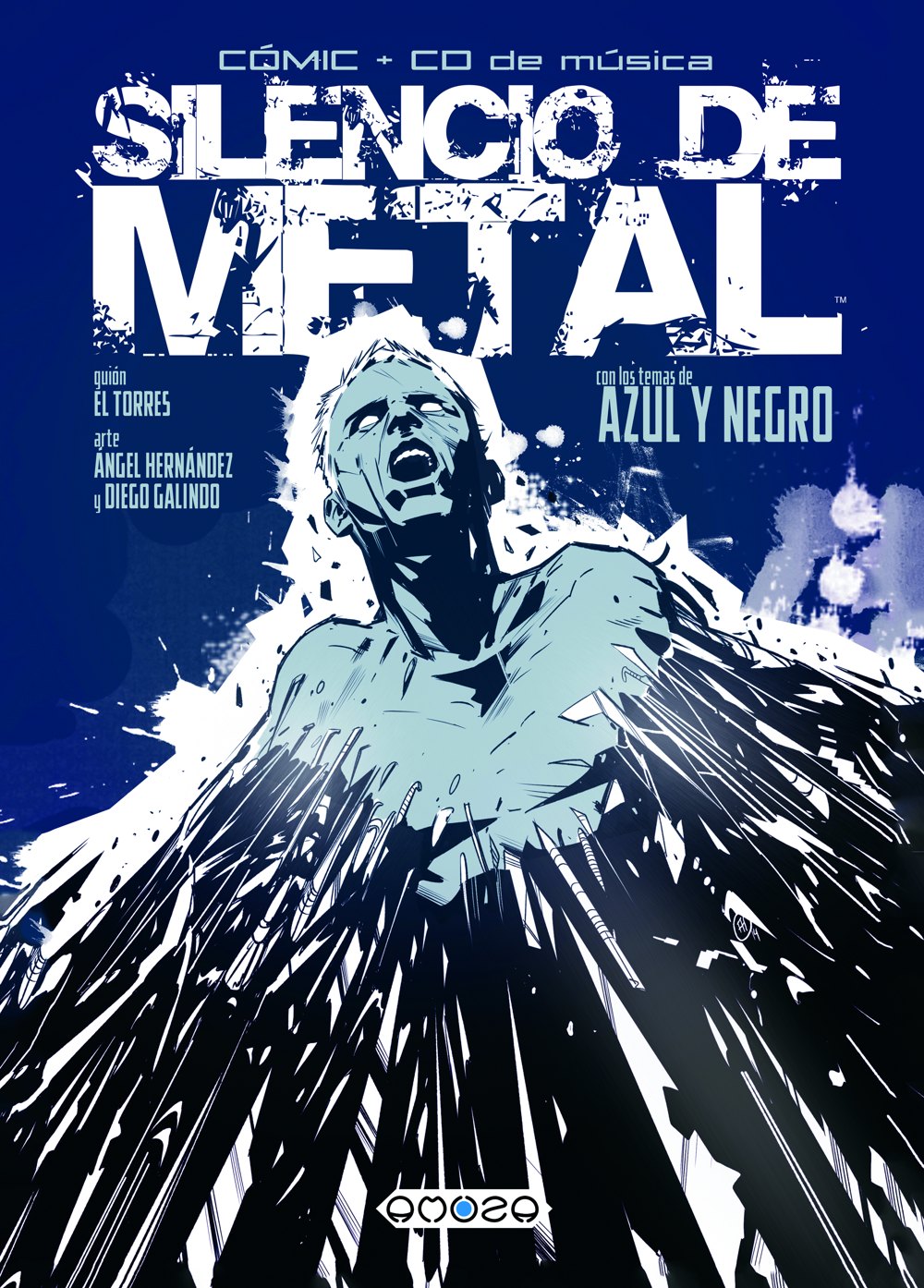
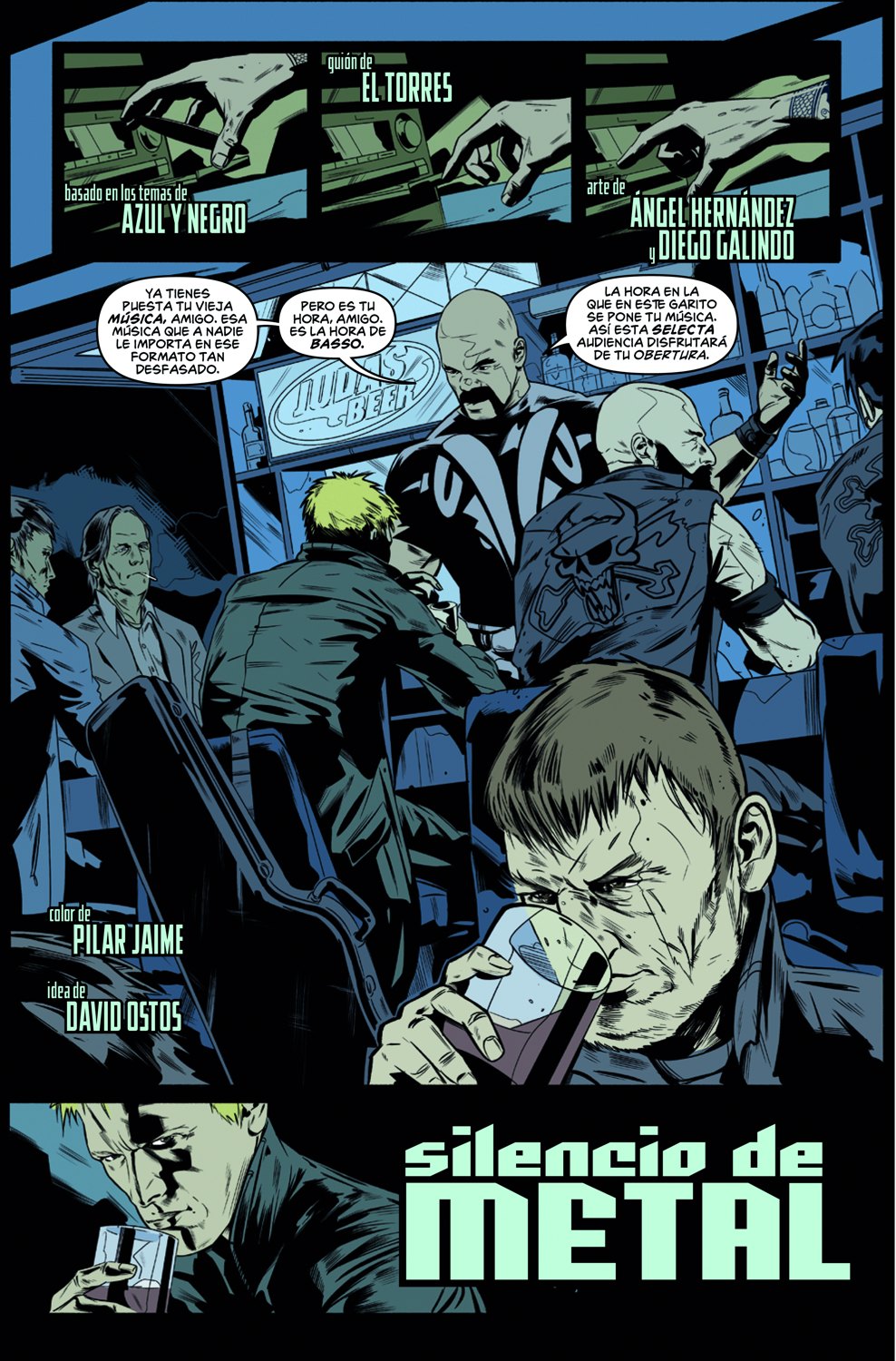
Ángel Hernández’s cover and the credits page. Bottom left, the part that matters: “idea de David Ostos”.
Silencio de metal
I took the song titles and turned them into a world. A dying, dehumanised future that only the very rich or the genetically lucky get to escape. A musician, Basso, who carries his guitar everywhere even though he no longer plays. A woman, Caroline, who has left. A well-connected psychopath they call Mannequin. A journey to the stars advertised on glowing billboards. Maniquí, Caroline, Romantic Warrior, Destino astral, Flying South, Heaven… Every song found its place in the story, and I even slipped in a wink that people my age will catch at once. A few pages in, someone asks Basso what’s wrong with him tonight. And Basso answers: “I’m going crazy.”
The result came out in December 2014: a 48-page book with a CD inside carrying fourteen Azul y Negro tracks, two of them previously unreleased. Ángel Hernández drew the first half and Diego Galindo the second, with colours by Pilar Jaime, helped by Sandra Molina. I wrote it, lettered it and designed it, since I was the one closest to hand.
And it had one detail I’m still proud of. The CD was stuck to the inside front cover, right on the first page of the story. When you took it out to play it, there was another disc drawn underneath, and someone saying: “Okay. Let’s play this already.” You turned the page and the barman told Basso: “Your old music is playing, friend.” The comic began, quite literally, the moment you pressed play.
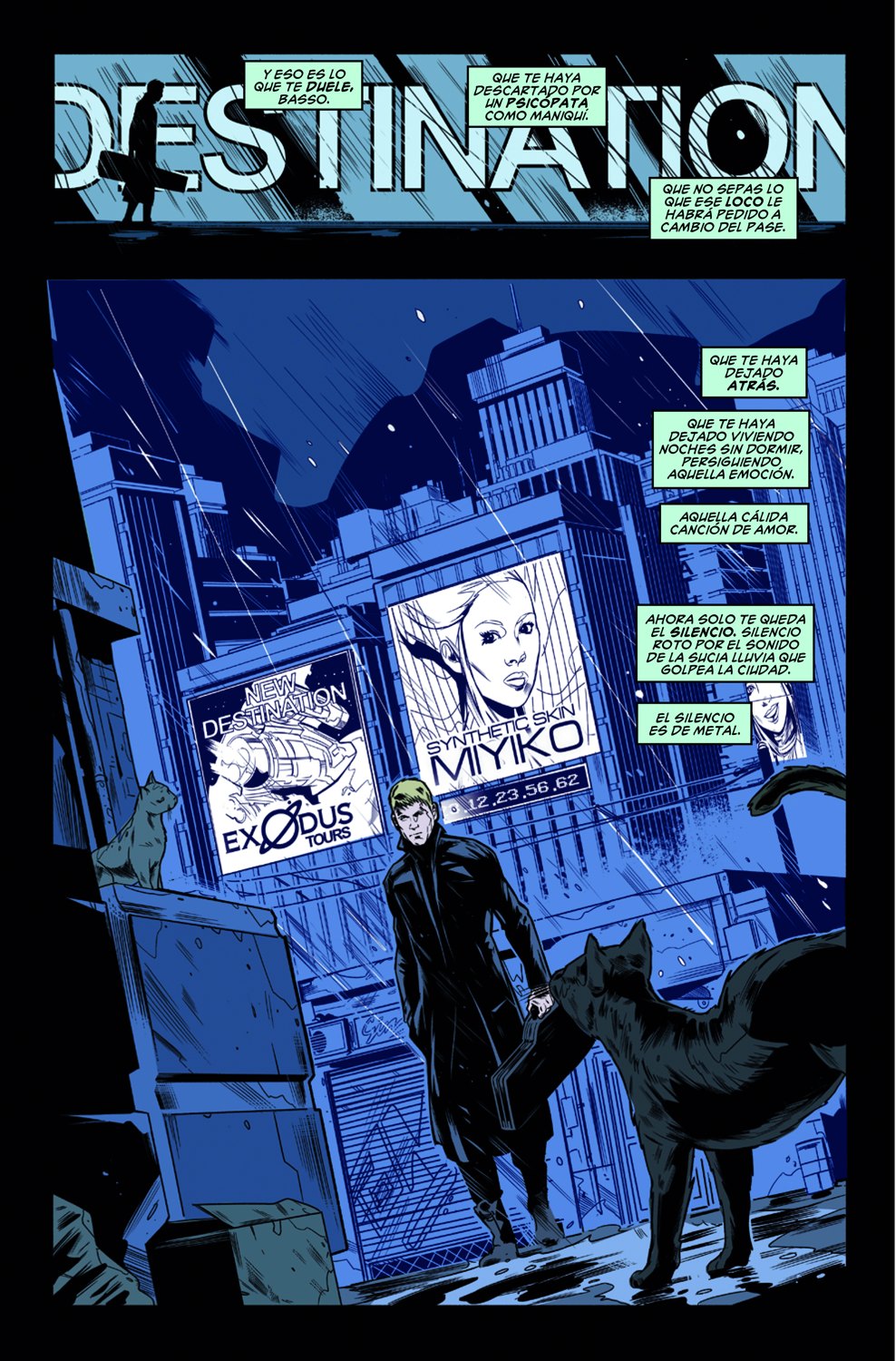
I think of it as a small gem in my bibliography. Small because it came out from a tiny publisher and is hard to find today; a gem because I have rarely enjoyed a job so much. And because it’s funny how the world turns: the kid who listened to Azul y Negro in his friend’s bedroom ended up writing a comic out of their songs, and it was that same friend’s fault.
A whole record for my monsters
If it had ended there, I’d already owe him a few beers. But David doesn’t know how to stop.
A few months later he hit me with the next one. He wanted to make a record. A record dedicated to my comics. Eleven musicians, eleven tracks, each inspired by one of my stories.
I thought he was joking. He wasn’t.
Little Book of Horrors came out in May 2015: a compilation of electronic and instrumental music in which eleven artists told, each in their own way, what they saw in my horror comics. Here’s the track list, and I still read it with a silly grin:
- The Veil, by Carlos López (already a member of Azul y Negro by then).
- Roman Ritual, by Cyborgdrive.
- Noche de Walpurgis, by Oculto, the name Carlos Vaso himself hides behind.
- Eclipse of the Undead, by Neosynth.
- The Conquest of Hearts, by Ibes Magora.
- 1000 veces, by Destino Plutón.
- Phantasmagoria, by Mist3fly.
- Nancy in Hell, by After the Rain.
- Aokigahara, by Die Stadt: the suicide forest, of course.
- Drums, by The Unknown.
- Black Letters, by Raúl Gonzalo.
It was mastered by Carlos Vaso. Yes, the man from Azul y Negro, the one who played guitar on records by Tino Casal and Mecano, mastering a record about my ghosts. If anyone had told me that in that bedroom, I’d have keeled over.
It was a limited edition of 450 copies, in a large digipack, almost a book, with a twenty-page booklet about the musicians and their tracks. All numbered, and all signed by yours truly. I designed the cover and the interior myself: if I was getting a tribute, I could at least keep my hands busy.
It’s hard to find today. If you ever spot it at a fair or in a second-hand shop, don’t think twice: it’s a beautiful record. And if you want an idea of what it was like, the two videos that introduced it are still out there: the teaser and the digipack presentation, both with music by Raúl Gonzalo.
And it didn’t stop at the record. To launch it, David organised a concert at La Caja Blanca, in Málaga. A concert dedicated to my comics, with live music and me sitting there, not knowing where to look.
I won’t lie to you: writing is lonely work. You spend your life in front of a screen, you send off the pages, the comic comes out and, with luck, someone at a signing tells you they liked it. And suddenly there you are, a piece of music is playing that someone composed because they read a story of yours, and you look beside you and there’s the friend you used to record nonsense with on a cassette, who is the one who organised the whole thing. Asking for nothing. Because he felt like it. Because he believed my work deserved it when I wasn’t so sure myself.
I’ve won awards and I’m grateful for every one. But few things in my life have moved me the way that did.
He was always there
This is what I’d like you to remember about David, beyond the titles and the dates. Some people have talent, and some people make other people’s talent happen. David is one of the second kind, who are far fewer and far more needed. He’s the one who makes the call, who puts the musician together with the artist, who finds the printer, who talks the sceptic round and who, when it all works out, goes and stands in the back row.
And he has always been there, backing me. When things worked out and when they didn’t.
You can’t repay that with a blog post, but you have to start somewhere.
And now, Taranta
A few days ago David sent me a music video and asked me a favour: to watch it, and to share it with anyone who might like it. He’s thrown himself into a documentary and its soundtrack.
The documentary is Taranta, and let me tell you about it, because the story deserves it.
It’s the first feature by Samuel Nacar, a documentary photographer with a World Press Photo to his name, produced by Sarao Films and Verbena Films. It’s set in Linares, one of the cities with the highest unemployment in Europe, where the Santana factory is reopening after years of abandonment, this time with Chinese industry behind it. The film follows two young people from Linares and two Chinese engineers as they decide what to do with their futures. It had its world premiere in the Official Selection of the Seville European Film Festival, it’s screening these days at Zinebi in Bilbao, it’s in the selection of the Premios Lorca in Granada, it has been shortlisted for the Feroz awards and nominated at the ASECAN Andalusian film awards for best non-fiction film and best original score.
And the music is where my friend comes in.
The original score is by Airyn, performed by Nukleus, the project Airyn shares with Juan Manuel Mantecón. The main theme was composed by Mantecón, who sings it with the flamenco singer Rocío Márquez, winner of the Lámpara Minera at the Cante de las Minas festival. Because that’s what a taranta is: a miners’ song, and Linares is mining country. The track blends electronics and flamenco and, note this, it uses historic recordings of Antonio Chacón from around 1917, held at the National Library of Spain, transformed through sampling and synthesis. A singer from a century ago fed into a synthesizer to tell the story of a factory today.
Part of all that was recorded at Creativa Sonora, where David is artistic director. All these years after the cassette deck, he’s still at it: making sure the electronic music made here gets where it deserves to go. Only now it gets to film festivals.
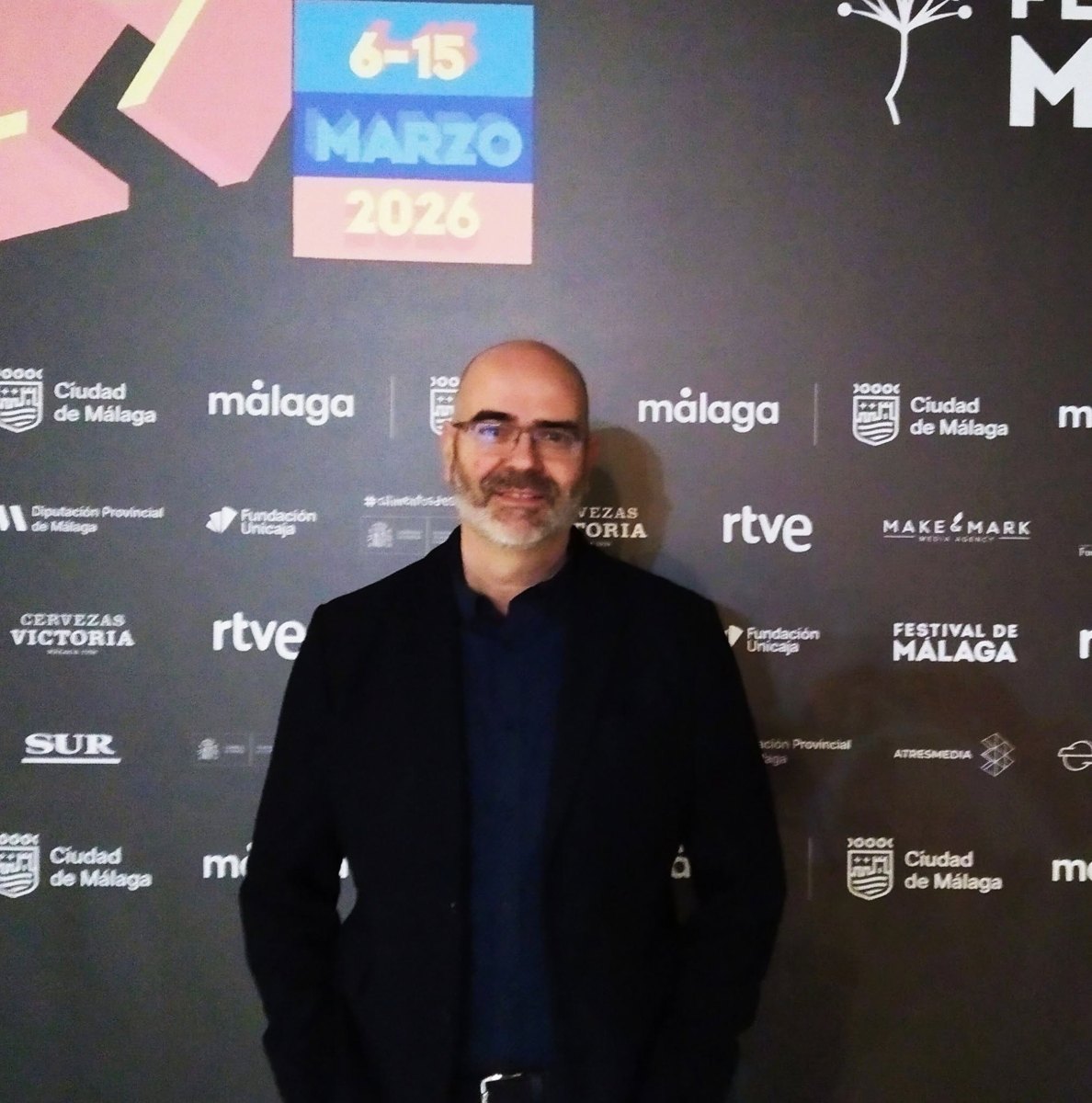
So I’m doing what he asked, and gladly:
- Watch the Taranta music video, with Rocío Márquez and JM Mantecón.
- Listen to the song.
- Have a look at the film’s page and, if you’re in Spain, go and see it: it opens in cinemas this Friday, 27 November.
And share it, which is the whole point. David has spent half his life pushing other people’s work, mine first of all. The least we can do is give his a push.
Thank you, David. For the records, for the comic, for that night at La Caja Blanca and for the bedroom where it all began. We owe each other a few beers.
I’ll bring the comics. You bring the music.